
Unlocking Resilience to Thrive Through Life's Ups and Downs
The Profound Influence of Our Energy Capacity On How We Experience Life…

Resilience Through an Energy Lens
Many of us think of resilience as our ability to “withstand,” “tough it out,” or “bounce back” from stress. But true resilience is deeper—and it begins with understanding our internal energy capacity and how energy flows through our system.
HeartMath defines resilience as “the ability to prepare for, recover from, and adapt to stress, adversity, trauma, or tragedy.” Framing resilience this way shows that resilience isn’t just responsive. It’s a skill we can build. And as we build our skill, we build our energy reserve. Central to this capacity is the emotional domain, where most energy leaks occur, quietly eroding focus, motivation, and connection.
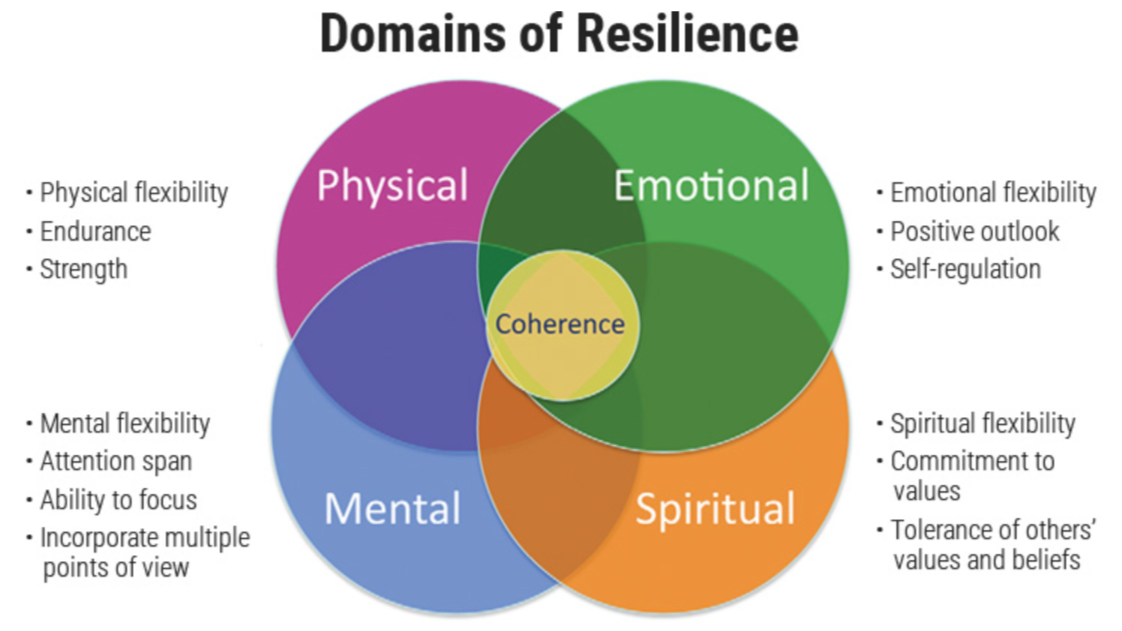
This kind of resilience is made up of specific characteristics across the Physical, Emotional, Mental, and Spiritual domains. Mapping resilience this way helps us see that it isn’t abstract—it’s rooted in tangible, interconnected capacities that we can observe, reflect on, and strengthen in ourselves and others. 🧘🏻♀️
Importantly, resilience is also about effective energy management. Once we understand this, we can notice what depletes our energy and what restores it. 🔆
The Four Domains of Resilience
Source: HeartMath Institute
HeartMath’s framework identifies four interconnected domains that contribute to resilience:
Physical resilience – the foundation for energy management. This domain reflects the body’s ability to adapt, recover, and maintain stability under stress. Practices that support physiological coherence—such as balanced breathing, rest, and mindful movement—strengthen endurance and stamina. 💪
Emotional resilience – the key to accessing renewing energy. Emotional drains can impact our resilience more than any other factor. By learning to shift from draining states like frustration or anxiety to renewing ones like appreciation and calm, we increase coherence, restore balance, and sustain inner stability. 💖
Mental resilience – clarity, focus, and cognitive flexibility. When the emotional system is regulated and the heart and brain are in sync, the mind functions more effectively. Coherent states enhance our ability to think clearly, make good decisions, and maintain perspective under pressure. 🧠
Spiritual resilience – connection to meaning, purpose, and values. This domain reflects our alignment with what truly matters. Staying connected to deeper purpose and heart-based intuition sustains energy, perspective, and a sense of coherence even through uncertainty and change. ✨
Each domain interacts with the others. Growth in one strengthens the whole system; depletion in one ripples across all areas.
Even more compelling—the emotional domain is the one that drains our energy reserves the most. Worry, frustration, impatience, and overextension can quietly deplete our reserves without us noticing. Awareness of these emotional energy leaks allows us to prioritize practices that protect and restore our energy.
Practices That Strengthen Resilience
We can support our resilience by:
Observing and assessing our energy across all four domains—before, during, and after stress
Proactively engaging in practices that build energy reserves before stress arises
Using coherence and regulation tools during stressful moments to reduce emotional energy drains
Continuing restorative practices after stress to support recovery and replenishment
HeartMath’s Quick Coherence and Inner Ease techniques are powerful ways to align heart, mind, and body. By regulating emotions, we stop the largest energy leaks and restore clarity, composure, and balance. Explore their free eBook for a deeper dive: Resilience and the Emotional Landscape
I’m also a huge proponent of co-regulation practices, because resilience isn’t built in isolation—it grows through connection. Trusted relationships, coaching, therapy, community, or even shared breath can help us feel safer, calmer, and more resourced together.
Resilience is a skill—and like any skill or muscle, we can build it with awareness and practice, increasing our energy reserves in the process.
Reflection
Consider how you might nurture your resilience—both individually and collectively.
Where do you feel most resourced right now—physically, emotionally, mentally, or spiritually?
Is there a small practice that could restore or recharge your energy as you move through your day? Is it one you could share with your team or loved ones or even someone you don’t know?
__
Julie Bauch is a deep transformational coach who supports individuals, leaders, groups, and organizations. Her work draws from neuroscience, wisdom traditions, somatic healing practices, Integral Coaching®, the work of Thomas Hübl, and a deep commitment to inner and outer coherence.
