
The Joy and Trepidation of Beginning Again: Lessons on Growth, Identity, and Leadership
Why real growth often starts when we become beginners again
Sometimes, the paths we’ve mastered stop feeling like ours.
The skills that made us successful can become the scaffolding that limits us.
Growth often begins when we dare to become beginners again.

I spent most of my career becoming an expert.
And eventually, a leader.
By most conventional measures, I succeeded at both.
But just as I was reaching the point where I expected to cement my leadership in that industry, something inside me began to fracture.
What had once felt meaningful no longer did. And slowly, uncomfortably, I began to realize that I might be contributing to building a version of the world I didn’t actually want to live in.
At the time, I didn’t have language for what was happening. I only knew that something within me was beginning to feel deeply out of alignment. What had once brought me energy and meaning slowly stopped doing so.
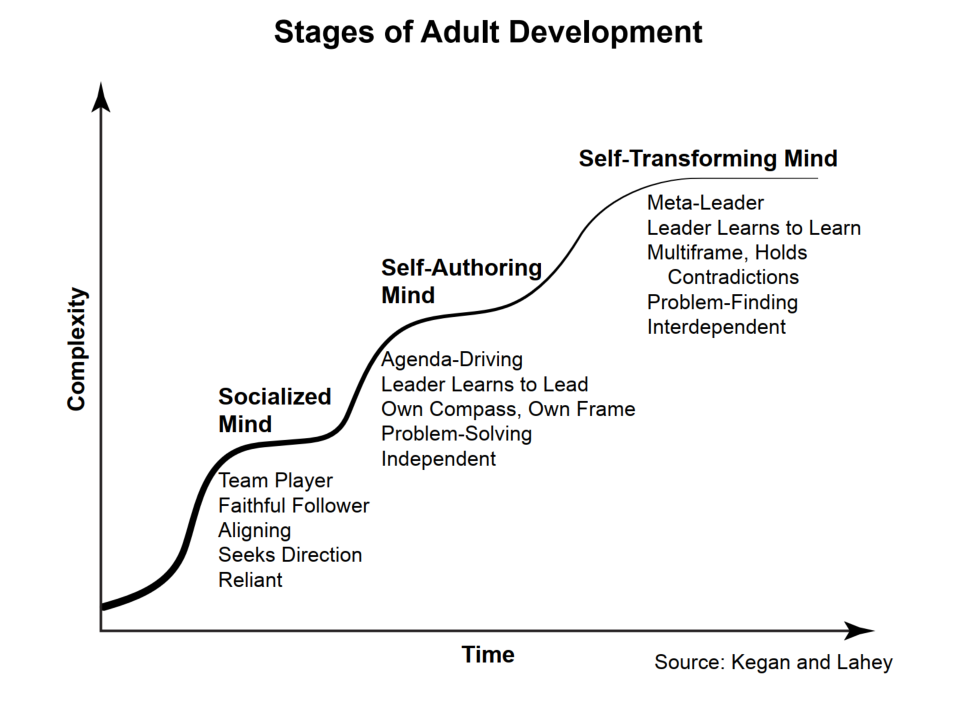
Developmental psychologist Robert Kegan writes that adult growth often requires a transformation in the very system of meaning through which we understand ourselves. The identity that once organized our life eventually becomes too small for what is trying to emerge next.
As our capacity to hold complexity grows, we move from what he calls the socialized mind toward stages of self-authorship and eventually self-transformation. I often think of these as increasing levels of personal agency.
Paradoxically, when this happens, it can feel deeply unsettling. Much of our self-identity is tied to the commitments we’ve built our lives around. The parts of us invested in those commitments often resist recognizing when they are no longer aligned.
That was certainly true for me.
The realization didn’t arrive all at once. It crept in slowly over several years.
At first I redirected some of my attention. I got involved in impact and sustainability initiatives as part of my existing roles. That allowed me to build something new within my organizations that aligned closely with my focus on growth and transformation.
I also focused more on friendships, hobbies, and life outside of work. Over time I noticed that my social world was beginning to diverge from my professional world, but that signal didn’t fully register for a while.
Eventually it became impossible to ignore.
I realized I had a profound inner conflict with the demands of my role. Not because of the role itself, but because it existed inside a broader context I could no longer support.
Realizing that was like having the bottom fall out from underneath me. And alongside that realization came fear.
The path I was on was one I understood. I believed in it. I had committed to it for decades. I knew how to navigate it.
I was also genuinely proud of the work I had done for the organizations I supported. Walking away meant leaving that behind and stepping into something completely unknown — something I didn’t yet have the words to define.
Eventually the inner conflict won out over fear because I saw that I was becoming someone I didn’t want to be.
For about a week, I experienced profound anxiety. Looking back, I now recognize it as my body’s signal that I was about to move through a barrier I had never allowed myself to cross before.
And the moment I finally decided, something surprising happened.
The anxiety that had been holding me in place began to dissolve.
I felt completely at peace.
Not because anything was suddenly clear beyond the one step I knew I needed to take, but because I had stopped resisting what my entire being already knew.
When I stepped away, a much larger world began to open.
But I can’t emphasize this enough: it didn’t happen all at once.
It unfolded like a breadcrumb trail.
And in many ways, it still does.
What I initially imagined would be a one-year sabbatical that ended with me returning to the corporate world turned into a deeper period of exploration. I studied sustainability at MIT, immersed myself in leadership and development work, and began exploring nervous system regulation, trauma healing, systems thinking and personal transformation.
Slowly, my entire definition of leadership began to change.
What’s clear to me now — though I didn’t have language for it at the time — is that meaningful growth often requires us to outgrow the identities that once enabled us to become successful.
The competencies that build expertise also become the scaffolding of our self-concept. When life begins inviting us beyond them, the transition can feel less like learning something new and more like letting go of who we think we are.
And that can be terrifying.
I think it was the Gautama Buddha who said:
“When you have reached the opposite shore, you do not carry the raft on your back, but leave it behind.”
That’s easier said than done.
It’s been three years since that turning point.
I’ve spent much of that time rediscovering who I am today and learning the things that genuinely excite me now: completing coaching certification, studying coherence and self-regulation, developmental psychology, trauma-healing, and contemplative practice.
I’ve also been working with individual clients around growth and transformation — the thread that quietly runs through every chapter of my life.
And recently I realized something surprising.
Life is inviting me to become a beginner again.
This realization arrived while I was on my yoga mat in downward facing dog. It wasn’t dramatic. Just a quiet thought that surfaced with surprising clarity:
“I am walking through territory I have never explored before.”
And I can feel that it’s a larger territory than I’ve ever allowed myself to inhabit.
I know I didn’t have the inner tools to be here before.
I know it’s new because it feels a bit vulnerable and exposed. There is less formal structure here. Fewer rules. And because of that, more freedom to build something that’s uniquely mine.
At times this freedom can feel like trying to decide what to order from one of those old-school diner menus that are a mile long.
I’m hungry, and suddenly there are so many possible choices.
Part of me just wants someone to tell me what to order.
But I know that voice is the part of me that feels scared rather than excited.
She’s welcome too.
Still, the deeper question remains:
“Within all of this, what is actually mine to do?”
Answering that question requires something different than expertise.
It requires listening deeply. Breathing. Staying in contact with myself. Becoming curious about what is emerging.
It requires letting go of rigid ideas about who I am and where I’m “supposed” to be so I can experience what is actually here.
And perhaps one day become a vessel for something that is both more than just me and also uniquely my own.
Psychologist Carol Dweck has shown that learning accelerates when we move from a performance orientation—where we try to prove what we already know—to a growth orientation grounded in curiosity and exploration.
In other words, true learning often requires us to return to beginner territory.
Beginners are alive in beautiful ways.
They notice more.
They ask better questions.
They remain open to what is emerging rather than getting sidelined by what they “already know.”
There is humility in being a beginner.
And there is freedom.
The more I observe growth — in leadership, in relationships, and in my own life — the more I see this pattern clearly.
Each meaningful stage of development eventually asks us to begin again.
I’m beginning to realize something else: this pattern doesn’t only show up in careers. It shows up across life.
Which brings me to why I started writing here.
This space is an experiment in thinking out loud about the deeper work of growth, healing, and transformation. A place to explore the intersections of life, leadership, identity, and healing.
Not from the position of having everything figured out, but from a place of curiosity about how development actually unfolds.
Because the more I support transformation in myself and others, the more convinced I become that wisdom is less about having final answers and more about remaining in relationship with meaningful questions.
So here I am.
A former expert and leader in one arena, now willingly a beginner in another.
There is vulnerability in that.
But there is also a surprising sense of being supported.
And a deep realization that this willingness to explore is what true leadership is.
Because beginning again is not a step backward.
It is the doorway to the next stage of growth — if we allow it to be.
No matter how accomplished we become, life eventually invites us back to the beginning.
The real question is whether we meet that invitation with resistance…
or with curiosity.
Reflection
Where in your life might you be standing at the edge of beginner territory?
👉🏻 It could be in your work.
👉🏻 In a relationship.
👉🏻 In how you relate to yourself.
👉🏻 Or in a new identity that is slowly forming.
Notice what arises when you consider that possibility.
🤩 Excitement.
🥹 Resistance.
😩 Uncertainty.
All of these are natural responses to the unfamiliar.
If you’re willing, try a small experiment this week.
Choose one area of your life where you might allow yourself to be a conscious beginner.
See if you can approach it with curiosity rather than performance.
Ask questions instead of rushing toward answers.
You may discover that the beginner’s path is not a regression at all.
It is simply where growth begins.
And more often than we expect, growth begins when we find ourselves back in the deep end, learning how to swim again. 🙏🏼
___
Julie Bauch is a coach, advisor, healing facilitator, and strategic thought partner living in NYC. She helps individuals do the inner and relational work that strengthens their foundation so they can live and lead from their most authentic, aligned, and agentic self — and thrive in everything they do.
Her work draws from neuroscience, wisdom traditions, somatic healing practices, Integral Coaching®, the work of Thomas Hübl, and a deep commitment to inner and outer coherence.
Her writing lives at Reflections from the Deep End, and her coaching website lives here.
